The American Binary
Heroes and Villains: Artificial Intelligence and The Singularity or Collective Intelligence

Like all other American weeks, this week, we are entertained by three battles between two camps. Sadly, it is the drama available.
One:
Elon Musk, a once hero turned villain from the Democratic Party viewpoint (not unlike Donald Trump), has filed a lawsuit against a so-called fact-checker Media Matters, a self-proclaimed arbiter of truth in agreement with any good Democrat.
Two:
ChatGPT, the media sensation for 2023, spontaneously imploded because of a long-simmering feud between The Singularity crowd and venture fund Capitalists.
Three:
Financially a dichotomy accelerated into high gear with the summer exposure of another starling, effective altruist, Sam Bankman-Fried, as a fraud. And on November 21st, down went the other major Cryptocurrency exchange, Binance.
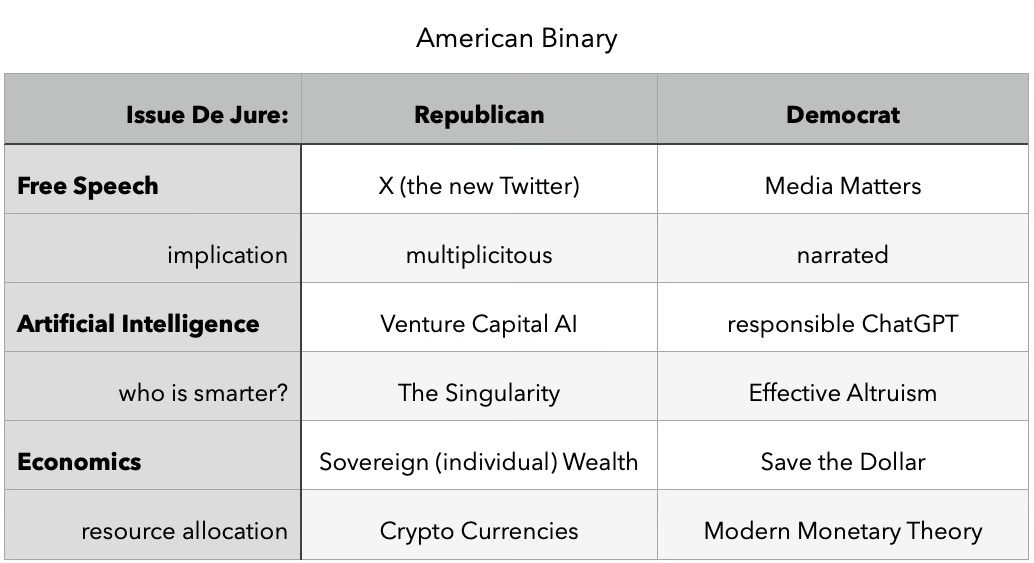
With a wonderful, attention-focusing coincidence, these dramas climaxed right before Thanksgiving. Typically stories imply one should choose a side based on one’s affiliation without understanding that complex issues have more than two solutions. Just like the Democrats, the Republicans also have predetermined a chosen narrative that their congregation, believers, or using more up-to-date lingo, to which their subscribers adhere.
Belief systems available in a binary world this Thanksgiving week:
Let’s review these underlying ideas, some new some decades old, that are currently clashing:
Capitalism is a 19th-century means of resource distribution without natural system limitations, such as “pigs get fat and hogs get slaughtered.”
Effective Altruism is a 21st-century governance belief system reacting to capitalism, pretending to be a business strategy.
Artificial Intelligence is a 20th-century individualist utopia scoured from many sources. It pretends to be a collective, yet is a competition to be the *smartest thing.*
The Singularity is a 21st-century individualist motivation, reacting to Artificial Intelligence, pretending to be historically and societally relevant, almost like a *final* governance system.
Collective Intelligence is a natural phenomenon witnessed in birds, bees, flies, fish, and human societies. As old as the universe itself.
Governance (and metabolism) is an instance of group management, where across millenniums of human civilizations, many strategies have been tested: communism, democracies, aristocracies, colonialism, corporatism, dynasties, socialism, theocracies, etc. And like OpenAI's Board of Directors (owners of ChatGPT) and the French Revolution, sometimes governance breaks bad.
Collective Intelligence is a phenomenon that exists at a scale larger than an individual actor/agent: intentionality visible of a collective is inherently observed from a scale larger than the individual actors. Most frequently, the actors do not know what effect their actions will have (again, look to Open AI’s Board of Directors).
Artificial Intelligence is the extraction of patterns from the specific collective of human beings in a given system: the set of people whose data has been collected. So-called intelligence compiled recalls the most frequently appearing patterns. Therefore, AI is a backward-looking prediction assistance tool, providing probabilities from prior actions. To make a forward-looking decision, some kind of judgment/expectation of effect is produced. The non-linear and non-rational judgment often witnessed in prized art or inventive solutions encapsulates a viewpoint, a consideration, or a theory of how the universe operates. Yes, data received by sensors is used to formulate the judgment. Even when processed by AI, the data itself is a step removed from human judgment about the behavior of natural systems.
Governance/Metabolism systems are used to regulate operations. Humans create them to regulate human systems: state governments regulate large-population geographies. Humans develop these systems based on frequently appearing patterns. And we look for inspiration from the universe for a deeper understanding of such regulations.
Effective Altruism and The Singularity are hypothetical governance systems based on a limited understanding of the universe’s, or nature’s, regulatory systems. They are opposite approaches to governance: E.A. is socially inspired, and The S. is mechanistically inspired. Both foresee humans as the central actors; this becomes a limitation. And in this attractively self-centered manner, E.A. & The S. attribute special powers to each of us. In today’s parlance, they are competing for our attention: E.A. makes us sound like powerful actors creating Good, and The S. makes us sound like influential participants resolving the universe into One.
However, they are both short-circuited by a 500-year-old Renaissance limited viewpoint, which elevated the individual to the agentive human actor or sole information processor. It led to the idea that rare individual geniuses change the world. Such individualized processing does not explain "multiple independent discoveries” in human history. With two fixed outcomes powerfully creating Good or resolving the universe into One, it is not surprising that subscribers to both ideas harbor religious feelings. As such, E.A. and The S. negate collective work and collective intelligence's information processing in natural living systems.
Standing on the Shoulders of Giants
Many attribute this phrase to Newton, yet it was not a new idea in 1676. Before the Renaissance, the theologian and author John of Salisbury wrote a version of the phrase in Latin in 1159. An approximate translation is:
"We are like dwarfs sitting on the shoulders of giants. We see more things that are more distant than they did, not because our sight is superior or because we are taller than them, but because they raise us up, and by their great stature add to ours."
This philosophical viewpoint paints the falsity of fear-inducing phrases like “AI replacing humans.” By contrast, artists and philosophers process information in complex and non-linear ways. They sense the environment to find resonance across space and time, corresponding to current experiences. Such work depicts, visualizes, or makes apparent how Collective Intelligence evolves with the universe.
November 24th:
What of Q*, the AI Model supposedly able to surpass humans in most economically valuable tasks, that may have caused confusion among the Board of Directors at OpenAI? It begins with a new category named Artificial General Intelligence (AGI) because it can solve math problems in addition to text-based queries. And yet, without being embodied in multiple, independently acting agents, it cannot produce Collective Intelligence. It remains another tool.
Essentially, even the most advanced AGI remains outside the realm of a civilization. AI may become the smartest body in the room. Yet, it still needs to grapple with being one of many in a group that exhibits collective behavior: in a group, society, humanity, or the universe itself. Furthermore, inside each group will be philosophers and artists who use AGI tools to sense the environment in non-linear, non-rational ways.
Because it’s all fun and games until someone gets hurt, it seems like we should use AGI to avoid large-scale human destruction and planetary disease. Societies will continue to evolve, and just like we used aqueducts to bring water to Rome, humans will use AI tools to form Collectively Intelligent behaviors inside the universe. Today’s challenges are the most significant scale challenges humans have faced on the planet; we should be using AGI to understand ourselves.
Economics: Crypto FTX Binance
Resource distribution, or how to unwind the USD. Looking at the chart, it appears a third means of distributing resources will emerge that is not dependent upon a Libertarian Crypto Currency or the American USD.
The chart simply outlines the binary choice for an American audience. However, Collective Intelligence will be experienced globally, so America’s binary option does not limit most actors.